Empowering Impact: How DRIIV is Redefining CSR through Science and Innovation
Get link
Facebook
X
Pinterest
Email
Other Apps
Empowering Impact: How DRIIV is Redefining CSR through Science and Innovation
Introduction
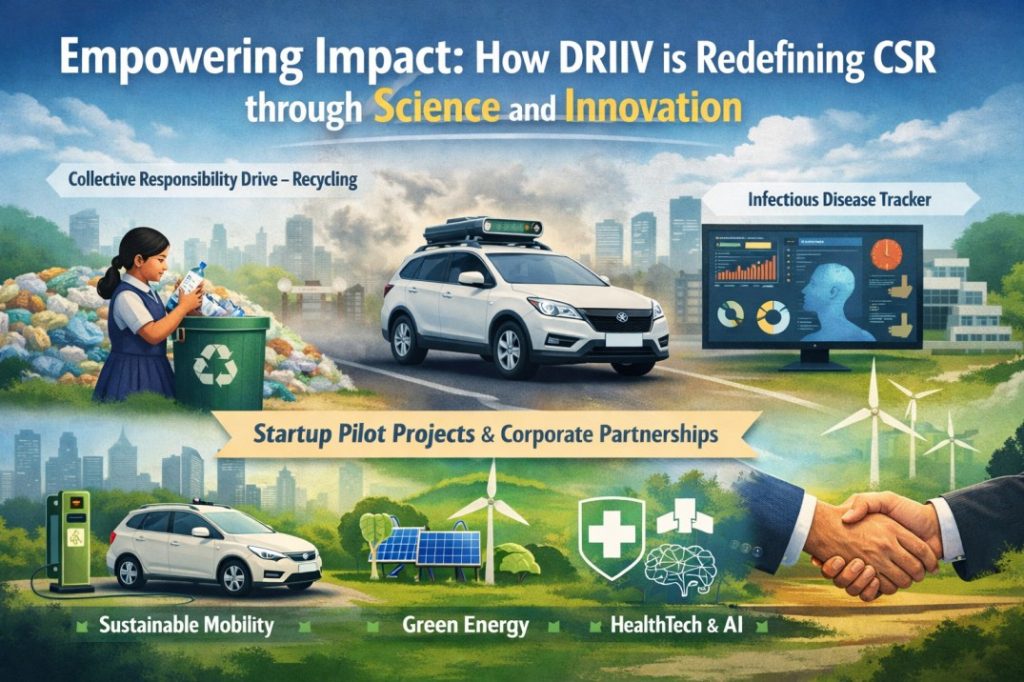
In today’s corporate landscape, Corporate Social Responsibility (CSR) has evolved from simple philanthropy into a strategic tool for sustainable development. DRIIV (Delhi Research Implementation and Innovation) is at the forefront of this evolution, acting as a unique bridge between innovative startups and corporate sustainability goals. By strategically matching cutting-edge technologies with corporate ESG (Environmental, Social, and Governance) targets, DRIIV transforms traditional CSR commitments into high-impact innovation opportunities.
The Power of CSR Capital: Bridging the Implementation Gap
For many deep-tech startups, the transition from lab to market is hindered by a lack of funding for real-world pilot implementation.
Through this platform, startups gain direct access to:
CSR support for use-case based pilot implementations
Real-world validation of their solutions in urban and industrial settings
Long-term partnerships with established corporate entities
Scalable social impact across diverse communities
Innovation in Action
DRIIV’s CSR projects demonstrate the tangible benefits of aligning technological innovation with community welfare.
DRIIV launched the Collective Responsibility Drive (CRD) to foster a circular economy through behavioural change in schools.
The Mission Targeting ~10 million youth to collect and segregate ~1 billion tonnes plastic items.
The Impact Collected plastic is upcycled into school benches for government schools, funded by REC Foundation, REC-PDCL, BPCL, and many more.
2. Turning Vehicles into Mobile Air Purifiers
Under DRIIV’s Project SAMEER, the RSPL Welfare Foundation supported the ShudhVayu Innovation Project to tackle Delhi NCR’s air crisis.
The Innovation ~50 vehicles (4W) were equipped with energy-free, roof-mounted air filters.
The Result These mobile units captured ~3,245 grams of particulate matter during peak pollution periods, proving the efficacy of public-private partnerships (PPPs) in urban air cleaning.
3. Data-Driven Public Health: Infectious Disease Tracker
Addressing vulnerabilities exposed by the pandemic, DRIIV developed a data-driven Infectious Disease Surveillance System.
Features An AI/ML-enabled platform for predictive modeling of case surges and antimicrobial resistance (AMR).
Outcome Provides policy-supportive dashboards for state-level pandemic preparedness, ensuring that health systems are future-ready.
Investment Showcase: A Pathway to Scale
Beyond CSR, DRIIV’s Investment Showcase identifies high-potential startups in sectors such as:
By providing a high-visibility platform for these innovators, DRIIV ensures they attract the necessary risk capital to move beyond pilots and into national-scale deployment.
Frequently Asked Questions (FAQs)
How does DRIIV help corporates achieve their SDG targets? DRIIV matches specific corporate sustainability needs with validated startup technologies, ensuring that CSR funds result in measurable, science-backed environmental and social outcomes.
How are DRIIV’s CSR projects validated? Projects undergo rigorous technical validation by DRIIV’s experts and academic partners to ensure the reported impact is scientifically accurate.
How can a startup apply for CSR Capital? Startups can register their technology through the DRIIV portal to be considered for upcoming pilot challenges and corporate matching opportunities.
Is DRIIV’s CSR model limited to the Delhi-NCR region? While many pilots start in Delhi-NCR, the models are designed for nationwide scalability, as seen with the Project AirView+ expansion to Gurugram and the infectious disease tracker’s national compliance.
Air pollution is a growing concern in India, especially in urban areas. With rising traffic, construction, and industrial activities, the quality of air continues to decline, affecting the health of millions. To address this, scientists and innovators are now developing effective technologies to control air pollution . At DRIIV (Delhi Research Implementation and Innovation), we are proud to support such solutions that bring cleaner air and healthier lives. One such technology is the use of Cyclonic Separators . These are mechanical devices that remove dust and other particles from air or gas without the use of filters. Cyclonic Separators use the power of air rotation and gravity to separate heavier pollutants from cleaner air. They are especially useful in industries where large volumes of dust are produced. By trapping these particles early, they prevent harmful substances from entering the atmosphere. Another important innovation is Smog Towers . These are tall, air-purifying stru...
G20-CSAR: Championing Open Access for Global Climate and Health Equity In an era where environmental shifts and public health crises are increasingly intertwined, the democratization of scientific knowledge has become a global necessity. Under the aegis of the G20 Chief Science Advisers’ Roundtable (CSAR) , DRIIV (Delhi Research Implementation and Innovation) organized a landmark side event on August 8, 2023 . The conference, titled “Role of Open Access in Equitable Climate and Health Action: Prevention, Response, and Financing,” emerged as a critical platform for fostering international dialogue. It addressed the complex synergy between climate change and human health, highlighting how restricted access to data can hinder global resilience. Key Highlights of the Event Bridging the Data Divide The event emphasized that equitable solutions to climate change mitigation and public health preparedness are only possible when research, data, and reso...
The Global Power of Collaboration: Top 5 Science and Technology Clusters Shaping the Future In the global race for technological leadership, innovation no longer happens in isolation. The most significant breakthroughs of the 21st century emerge from Science and Technology (S&T) Clusters —dynamic ecosystems where elite universities, deep-tech startups, R&D labs, and industry giants converge under a unified policy framework. As India accelerates toward Viksit Bharat 2047 , these global benchmarks provide a roadmap for our own growth. What Defines a World-Class S&T Cluster? An S&T Cluster is more than a geographical location; it is a translational research engine . Its success is built on the Triple Helix Model —the seamless collaboration between: Industry Academia Government This synergy reduces the lab-to-market timeline, ensures that research solves real-world administrative and societal challenges, and drives sustainable economic gro...


Comments
Post a Comment