Powering the Future: Scaling India’s EV Charging Infrastructure
Get link
Facebook
X
Pinterest
Email
Other Apps
Powering the Future: Scaling India’s EV Charging Infrastructure
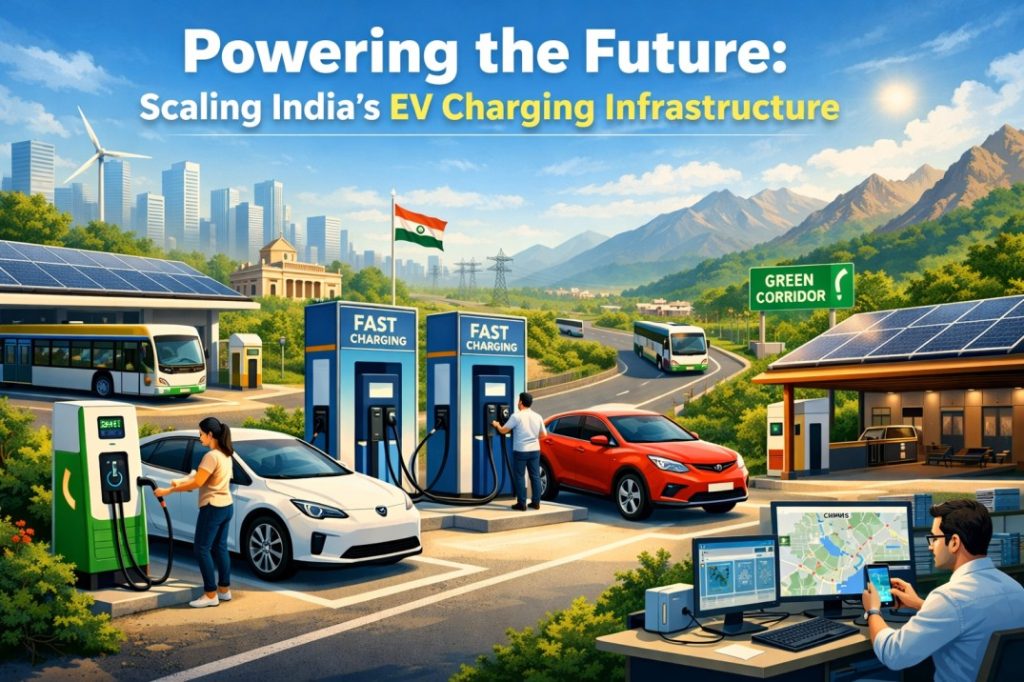
India’s electric mobility transition has moved past the “early adopter” phase and is now entering a period of rapid industrial scaling. Central to this shift is the expansion of a robust, reliable, and accessible EV Charging Infrastructure.
With over 29,150 public charging stations now operational across the country—a five-fold increase since 2022—India is building the backbone of its Net-Zero 2070 commitment.
Policy Push: From FAME-II to PM E-DRIVE
The government has intensified its support through strategic financial outlays. While the FAME-II scheme laid the groundwork by installing nearly 9,000 chargers, the newly launched PM E-DRIVE (PM Electric Drive Revolution in Innovative Vehicle Enhancement) scheme takes it further.
With a total outlay of ₹10,900 crore, the scheme earmarks ₹2,000 crore exclusively for charging infrastructure, aiming to install 72,300 public chargers by 2026.
Key Regulatory Reforms Lowering Market Barriers
Unlicensed Activity: Setting up an EV charging station is now a de-licensed activity, allowing private entrepreneurs and startups to participate freely.
100% Subsidies: Under PM E-DRIVE, specific locations like government buildings and schools can qualify for up to 100% capital subsidy on upstream infrastructure.
DRIIV: Driving Innovation and Regional Connectivity
As a science and technology cluster, DRIIV is bridging the gap between policy and on-ground deployment through Deep-Tech and Translational Research.
Smart Charging Solutions
An ecosystem partner of DRIIV has developed versatile AC and home chargers with IoT connectivity (WiFi/4G) and a specialized Charging Management System (CMS) to reduce user wait times.
Green Corridors
DRIIV is supporting the execution of a recently signed landmark MoU between a startup partner and the Government of Himachal Pradesh to establish 22 fast-charging stations across major national highways.
Implemented under a 40-year PPP model, the project envisages uplifting the travel experience by integrating technology interventions to address range anxiety and enable seamless EV mobility in challenging hilly terrains, along with modern wayside amenities.
Solarized Depots
In a mission to “green” the grid, DRIIV is planning to work with the Delhi Transport Corporation (DTC) and leading power utility discoms to solarize EV charging at bus depots, creating a replicable model for sustainable urban transport.
Frequently Asked Questions (FAQs)
What is the primary goal of the PM E-DRIVE scheme for charging? It aims to install over 72,000 public chargers, including fast chargers for e-4Ws and specialized chargers for e-buses.
How does the EV Corridor project in Himachal Pradesh help travelers? It establishes Green Corridors with fast-charging stations and wayside amenities like restaurants and rest areas along highways.
Can individuals set up EV charging stations in India? Yes, the Ministry of Power has made EV charging an unlicensed activity, allowing anyone to set up stations following safety standards.
What is “Solarized EV Infrastructure”? It is a system where charging stations are powered by solar energy, ensuring that the electricity used to charge EVs is truly carbon-free.
How does a Charging Management System (CMS) improve the EV experience? It allows users to remotely locate available chargers and book slots via mobile apps, preventing congestion at stations.
Air pollution is a growing concern in India, especially in urban areas. With rising traffic, construction, and industrial activities, the quality of air continues to decline, affecting the health of millions. To address this, scientists and innovators are now developing effective technologies to control air pollution . At DRIIV (Delhi Research Implementation and Innovation), we are proud to support such solutions that bring cleaner air and healthier lives. One such technology is the use of Cyclonic Separators . These are mechanical devices that remove dust and other particles from air or gas without the use of filters. Cyclonic Separators use the power of air rotation and gravity to separate heavier pollutants from cleaner air. They are especially useful in industries where large volumes of dust are produced. By trapping these particles early, they prevent harmful substances from entering the atmosphere. Another important innovation is Smog Towers . These are tall, air-purifying stru...
G20-CSAR: Championing Open Access for Global Climate and Health Equity In an era where environmental shifts and public health crises are increasingly intertwined, the democratization of scientific knowledge has become a global necessity. Under the aegis of the G20 Chief Science Advisers’ Roundtable (CSAR) , DRIIV (Delhi Research Implementation and Innovation) organized a landmark side event on August 8, 2023 . The conference, titled “Role of Open Access in Equitable Climate and Health Action: Prevention, Response, and Financing,” emerged as a critical platform for fostering international dialogue. It addressed the complex synergy between climate change and human health, highlighting how restricted access to data can hinder global resilience. Key Highlights of the Event Bridging the Data Divide The event emphasized that equitable solutions to climate change mitigation and public health preparedness are only possible when research, data, and reso...
The Global Power of Collaboration: Top 5 Science and Technology Clusters Shaping the Future In the global race for technological leadership, innovation no longer happens in isolation. The most significant breakthroughs of the 21st century emerge from Science and Technology (S&T) Clusters —dynamic ecosystems where elite universities, deep-tech startups, R&D labs, and industry giants converge under a unified policy framework. As India accelerates toward Viksit Bharat 2047 , these global benchmarks provide a roadmap for our own growth. What Defines a World-Class S&T Cluster? An S&T Cluster is more than a geographical location; it is a translational research engine . Its success is built on the Triple Helix Model —the seamless collaboration between: Industry Academia Government This synergy reduces the lab-to-market timeline, ensures that research solves real-world administrative and societal challenges, and drives sustainable economic gro...


Comments
Post a Comment